
The global dental impression trays market, valued at USD 532.37 million in 2024, is projected to reach USD 1,283.63 million by 2034, growing at a robust CAGR of 9.20%. This growth is driven by rising dental procedures, technological advancements, and increasing demand for precise dental impressions.
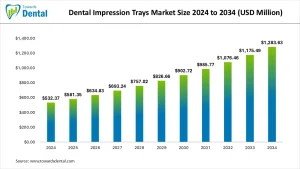
What Key Market Dynamics Are Shaping the Global Dental Impression Tray Market?
The dental impression tray market is a traditional cluster within restorative and prosthetic dentistry, as it provides the support system on which accurate negative impressions of a patient’s oral cavity can be made. Impression trays are standard, custom, and special trays that are used in the treatment of crowns, bridges, dentures, orthodontics, implants, and diagnostic modelling. Innovation around lightweight, rigid, perforated, and thermoplastic trays is a significant opportunity, and there is growing use of reusable autoclavable trays in advanced clinics seeking efficient cost-control solutions for infection control.
The replacement of traditional alginate impressions with high-precision silicone impressions is also putting pressure on trays designed to retain their dimensions. Key limitations, though, are the presence of low-cost non-standardized products, fears of inter-contamination in used trays, and less uptake of high-quality trays in low-end markets. Sustainability of the environment, including plastic waste from disposable trays, also restricts expansion in certain areas.
Why Are Regional Differences Influencing the Growth of the Dental Impression Tray Market Worldwide?
North America is an important market because of its well-developed dental facilities, high adoption of advanced prosthodontic procedures, and extensive use of digital impression systems that employ well-fitting trays in their hybrid procedures. The United States is still in the lead because the geriatric population is growing, dental spending is high, and there are well-established manufacturers of custom-fitted, autoclavable trays for implant-supported restorations.
Europe has been in close second place, with well-developed public health care systems, strict sterilization rules, and a constant increase in dental laboratories and specialty practices, with a great focus on accuracy in impression-taking.
The adoption of metal and polycarbonate trays, which are engineered to perfection, is high in such countries as Germany, the United Kingdom, Italy, and France. Asia-Pacific is emerging as the fastest-growing market for dental tourism in India, Thailand, and Malaysia, driven by rising middle-class expenditure and the growth of independent dental chains.
How Are Technological Innovations Transforming the Future of Dental Impression Trays?
The dental impression tray market is being transformed by technological progress and innovation, with manufacturers developing ergonomic, flexible, and anatomically optimized tray designs to enhance impression precision and reduce chair time and the need for implant-level fit. The AI design software is aiding in creating trays with effective retention design, perforation patterns, and weight distribution to enhance the accuracy of elastic impression materials.
Artificial intelligence is helping robotics to improve consistency and minimize failures of production, quality control, and inspection systems. With the introduction of accurate workflows and superior equipment to modernise dental clinics, the impression tray has emerged as an essential addition to the digital imaging system.
Dental Impression Trays Market Statical Scope
By Product
- Partial
- Full

Rohan Patil stands at the forefront of dental market research, leveraging over five years of specialized experience to navigate the intricate landscape of the global dental industry. As Principal Research Analyst at Towards Dental, he spearheads comprehensive research initiatives that encompass a broad spectrum of dental sectors, including orthodontics, periodontics, prosthodontics, and endodontics.
At Towards Dental, Rohan's expertise extends to analyzing emerging trends in dental technologies, regulatory frameworks, and market dynamics. He is instrumental in assessing the adoption of digital dentistry, advancements in dental materials, and the integration of artificial intelligence in diagnostic and treatment modalities.
Rohan's analytical acumen is complemented by his proficiency in translating complex data into actionable insights, enabling him to provide strategic recommendations that inform decision-making across the dental industry. His work not only supports dental professionals and organizations but also contributes to shaping the future trajectory of dental care globally. A trusted advisor and relentless innovator, Rohan continues to push the boundaries of traditional market research, merging scientific rigor with commercial insight to stay ahead in a fast-evolving dental landscape.
- Mobile Dental Unit Market Size to Attain USD 3.76 Billion by 2034 - January 6, 2026
- Dental Cone Beam CT Market Size to Attain USD 1,247.49 Million by 2034 - January 5, 2026
- Dental Resins Market Size to Lead USD 2.7 Billion by 2034 - January 2, 2026
Author
