
The dental laboratory handpieces market was valued at USD 1.92 billion in 2024 and is projected to reach nearly USD 3.25 billion by 2034, expanding at a CAGR of 5.40%. Growth is supported by rising prosthodontic workloads and digital dental lab adoption.
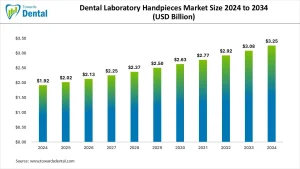
What Key Factors Are Driving, Restraining, and Shaping Opportunities in the Global Dental Laboratory Handpiece Market?
The dental laboratory handpiece market is a niche within dental equipment, commonly used in laboratories to grind, polish, cut, contour, shape, and finish dental prosthetics, orthodontic appliances, crowns, dentures, and implant components. The combination of brushless motors, multi-speed control units, enhanced thermal management systems, and ergonomic designs is opening up opportunities to reduce fatigue in high-volume laboratories.
The manufacturers are developing materials that enhance durability, torque transfer efficiency, and maintenance, and the laboratories are moving towards modular handpiece systems compatible with CAD/CAM workflows and milling technologies. The limitations of the market, however, include high prices for sophisticated electric handpieces, difficulty in maintaining the devices, noise-control problems in an outdated system, and the need to replace parts such as bearings, chucks, and burs.
Why Do Regional Dynamics Influence the Growth Pattern of the Dental Laboratory Handpiece Market Worldwide?
The dental laboratory handpiece market in North America is a significant market, as it has a well-developed dental technology system, embraces digital dentistry, and is an early adopter of high-speed, high-torque electric handpieces for precision prosthetics. The United States is at the forefront of a vast laboratory network dedicated to various fields of implantology, cosmetic dentistry, and restorations created by CAD/CAM systems, which underscores the need for durable, efficient handpieces that are easy to maintain.
Europe is a robust and consistent market with specialized dental laboratories in Germany, Italy, Switzerland, France, and the U.K., where demand is consistently high due to precision manufacturing and strict quality standards, resulting in a strong demand for technologically advanced devices. Asia-Pacific has the highest growth rate, driven by increasing dental tourism and dental laboratory establishments, and by consumers seeking aesthetic dentistry in India, China, Japan, and South Korea.
How Are Technological Advancements and AI Integration Transforming the Future of Dental Laboratory Handpieces?
The dental laboratory handpiece market is evolving as manufacturers introduce new-generation dental handpieces with digital controls, brushless micromotors, and AI-controlled monitoring. The handpieces are fitted with sensor-controlled torque, thermal load, and speed limit sensors that are self-controlled, enhancing precision in the equipment’s operation without wearing it out.
With the assistance of AI-based systems, rotational stability, predictive component failure, and optimized maintenance schedules are reducing downtime in busy labs. The trend of digital production, automation, and robotics is also penetrating the laboratory, compelling the need for handpieces that can easily blend into a manual-digital workflow.
Dental Laboratory Handpieces Market Statical Scope
By Product
- Electric Handpieces
- Air-Driven Handpieces
- Hybrid Handpieces

Rohan Patil stands at the forefront of dental market research, leveraging over five years of specialized experience to navigate the intricate landscape of the global dental industry. As Principal Research Analyst at Towards Dental, he spearheads comprehensive research initiatives that encompass a broad spectrum of dental sectors, including orthodontics, periodontics, prosthodontics, and endodontics.
At Towards Dental, Rohan's expertise extends to analyzing emerging trends in dental technologies, regulatory frameworks, and market dynamics. He is instrumental in assessing the adoption of digital dentistry, advancements in dental materials, and the integration of artificial intelligence in diagnostic and treatment modalities.
Rohan's analytical acumen is complemented by his proficiency in translating complex data into actionable insights, enabling him to provide strategic recommendations that inform decision-making across the dental industry. His work not only supports dental professionals and organizations but also contributes to shaping the future trajectory of dental care globally. A trusted advisor and relentless innovator, Rohan continues to push the boundaries of traditional market research, merging scientific rigor with commercial insight to stay ahead in a fast-evolving dental landscape.
- Mobile Dental Unit Market Size to Attain USD 3.76 Billion by 2034 - January 6, 2026
- Dental Cone Beam CT Market Size to Attain USD 1,247.49 Million by 2034 - January 5, 2026
- Dental Resins Market Size to Lead USD 2.7 Billion by 2034 - January 2, 2026
Author
