
The global dental orthotic devices market was valued at USD 7.26 billion in 2024 and is projected to reach USD 28.62 billion by 2034, growing at a robust CAGR of 14.7%, driven by increasing dental disorders and rising demand for oral care solutions.
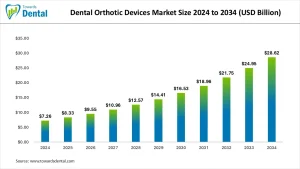
The dental orthotic devices market is made up of specialized intraoral appliances that are used to correct or control jaw, teeth, and temporomandibular joint disorders. The devices play an essential role in managing disorders like TMJ dysfunction, snoring, sleep apnea, and bruxism, in which the structural misalignment and muscle imbalance of the body influence the health of the mouth and the quality of life in general. The market of dental orthotic devices is also growing with new opportunities due to the increasing technology of materials and digital fabrication that supports personalization and longevity.
The enablers of growth include the increasing demand for minimally invasive treatment methods and the increasing incidence of sleep-disordered breathing disorders. Nevertheless, some limitations on the market can control its growth rate. The prohibitive nature of customized orthotic equipment, the shortage of trained orthodontic practitioners in the developing countries, as well as the insurance companies do not reimburse dental appliances, remain an obstacle to broad acceptance. Also, non-compliance by patients, especially in long-term use situations and early wear discomfort, may influence the results of the treatment.
Dental orthotic devices are experiencing different dynamics in the markets of the world. North America is leading, which is explained by the prevalence of TMJ disorders, the development of dental facilities, and the high number of professional orthodontic specialists. The US, especially, enjoys the advantage of a high rate of awareness that surrounds the management of sleep apnea and preventive dentistry.
Europe has been close right behind it, coupled with government healthcare programs, penetration of dental insurance, and fast adaptation of customized, digital orthodontic solutions in countries such as Germany, France, and the UK. In the meantime, the Asia-Pacific is becoming a prospective development area because of the increased healthcare spending, growing dental clinic chains, and the growing consumer emphasis on beauty and oral health. The adoption of dental orthotic devices is rapidly spreading in Japan, South Korea, and India as dental professionals are incorporating modern diagnostic devices and advanced treatment procedures.
The dental orthotics environment is still undergoing redefinitions due to technology, as the treatments become more accurate, efficient, and user-friendly. These innovations are very fast in upgrading the kind of time required to produce, and also reducing human error and enhancing the overall fit and effectiveness.
Artificial intelligence is also improving this ecosystem by streamlining the areas of diagnosis, treatment planning, and post-treatment follow-up. Images and simulating software are now capable of AI-assisted analysis of the bite patterns, prediction of the movement of the jaw, and tailoring of the orthotic to achieve the best therapeutic results. Moreover, AI algorithms can help clinicians detect subtle abnormalities of the TMJ as well as signs of sleep apnea, which increases the overall rate of early detection and intervention. Intelligent sensors installed in sophisticated dental appliances can monitor the wearing time, bite force, and compliance and relay the information to practitioners in real time to make corrections.
Dental Orthotic Devices Market Statical Scope
By Product Type
- Stabilization Dental Orthotic Devices
- Anterior Repositioning Dental Orthotic Devices
- Anterior Bite Plane Dental Orthotic Devices
- Posterior Bite Plane Dental Orthotic Devices
- Others

Rohan Patil stands at the forefront of dental market research, leveraging over five years of specialized experience to navigate the intricate landscape of the global dental industry. As Principal Research Analyst at Towards Dental, he spearheads comprehensive research initiatives that encompass a broad spectrum of dental sectors, including orthodontics, periodontics, prosthodontics, and endodontics.
At Towards Dental, Rohan's expertise extends to analyzing emerging trends in dental technologies, regulatory frameworks, and market dynamics. He is instrumental in assessing the adoption of digital dentistry, advancements in dental materials, and the integration of artificial intelligence in diagnostic and treatment modalities.
Rohan's analytical acumen is complemented by his proficiency in translating complex data into actionable insights, enabling him to provide strategic recommendations that inform decision-making across the dental industry. His work not only supports dental professionals and organizations but also contributes to shaping the future trajectory of dental care globally. A trusted advisor and relentless innovator, Rohan continues to push the boundaries of traditional market research, merging scientific rigor with commercial insight to stay ahead in a fast-evolving dental landscape.
- Mobile Dental Unit Market Size to Attain USD 3.76 Billion by 2034 - January 6, 2026
- Dental Cone Beam CT Market Size to Attain USD 1,247.49 Million by 2034 - January 5, 2026
- Dental Resins Market Size to Lead USD 2.7 Billion by 2034 - January 2, 2026
Author
