
The dental CAD/CAM and dental prosthesis market reached USD 2.19 billion in 2024 and is expected to rise to USD 5.63 billion by 2034 at a 9.9% CAGR, supported by digital dentistry adoption and demand for precise, customized restorations.
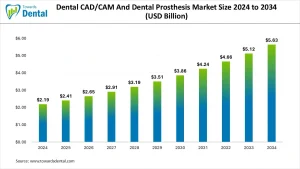
What Key Factors Are Driving Growth in the Global Dental CAD/CAM and Prosthesis Market?
CAD/CAM technologies save time, improve the precision of the fit, and enable mass customization of restorations, which is why they are the core of contemporary prosthodontics. The main opportunities stem from the growing burden of tooth loss and the aging population, as well as the rapid shift to electronic workflows in clinics and laboratories.
CAD/CAM systems and high-strength ceramics such as zirconia and lithium disilicate are becoming widely accepted clinically as patients demand aesthetic, durable, and same-day restorations. Also, increasing demands on minimally invasive esthetic surgery and the use of implant-supported prostheses ensure high demand for precision-milled prosthetics. Nonetheless, adoption is still constrained by market factors. The short penetration into small clinics is due to the high acquisition and maintenance costs of CAD/CAM systems.
How Are Regional Dynamics Influencing the Adoption of CAD/CAM and Digital Prosthodontics Worldwide?
North America leads the dental CAD/CAM and dental prosthesis market due to early adoption of digital dentistry, a high concentration of dental laboratories, and high demand for cosmetic and implant dentistry.
The US has been the most integrated in terms of intraoral scanners, chairside milling units, and cloud-based systems, which facilitate the manufacture of prostheses. Regional leadership is sustained by continuous clinical education, high penetration of dental insurance in the region for restorative care, and the presence of large international dental technology suppliers. Another significant market is Europe, which is fuelled by Germany, Italy, France, and the UK, where there is well well-established dental manufacturing sector and sophisticated prosthodontic education systems. ‘
How Are AI and Automation Transforming Design, Production, and Workflow Efficiency in Dental Prosthetics?
AI and automation are transforming the dental CAD/CAM and dental prosthesis markets by improving design processes, enhancing accuracy, and ensuring that humans do not interfere. The software, based on AI, automates margin marking, occlusal modeling, crown anatomy suggestions, and error detection, allowing dental laboratories and chairside users to achieve faster turnaround times. Scanners enhanced with machine learning can improve image stitching, soft-tissue differentiation, and impression accuracy.
CADs can be connected to the cloud, enabling remote collaboration between clinics and labs, and digital libraries will facilitate the customization of prosthetic designs. Constant improvements, such as hybrid chairside systems, AI-based prediction of occlusal adjustment, virtual articulations, and automated nesting systems, are more productive. In the future, innovations can also incorporate AI-based predictive wear analysis, robotics-assisted milling of prostheses, real-time simulations of force distribution in implant restorations, and fully autonomous labs that use AI-controlled quality control.
Dental CAD/CAM And Dental Prosthesis Market Statical Scope
By Material
- Ceramic
- Metal
- Resin

Rohan Patil stands at the forefront of dental market research, leveraging over five years of specialized experience to navigate the intricate landscape of the global dental industry. As Principal Research Analyst at Towards Dental, he spearheads comprehensive research initiatives that encompass a broad spectrum of dental sectors, including orthodontics, periodontics, prosthodontics, and endodontics.
At Towards Dental, Rohan's expertise extends to analyzing emerging trends in dental technologies, regulatory frameworks, and market dynamics. He is instrumental in assessing the adoption of digital dentistry, advancements in dental materials, and the integration of artificial intelligence in diagnostic and treatment modalities.
Rohan's analytical acumen is complemented by his proficiency in translating complex data into actionable insights, enabling him to provide strategic recommendations that inform decision-making across the dental industry. His work not only supports dental professionals and organizations but also contributes to shaping the future trajectory of dental care globally. A trusted advisor and relentless innovator, Rohan continues to push the boundaries of traditional market research, merging scientific rigor with commercial insight to stay ahead in a fast-evolving dental landscape.
- Mobile Dental Unit Market Size to Attain USD 3.76 Billion by 2034 - January 6, 2026
- Dental Cone Beam CT Market Size to Attain USD 1,247.49 Million by 2034 - January 5, 2026
- Dental Resins Market Size to Lead USD 2.7 Billion by 2034 - January 2, 2026
Author
