
The dental glass ionomer fillings market was valued at USD 1.24 billion in 2024 and is expected to reach nearly USD 2.08 billion by 2034, expanding at a 5.30% CAGR, driven by rising restorative procedures and demand for durable, biocompatible materials.
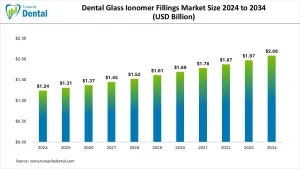
What Factors Are Driving Growth in the Global Dental Glass Ionomer Fillings Market?
The dental glass ionomer fillings market consists of restorative materials composed of glass ionomer cements (GICs), which possess chemical adhesion to tooth structure, fluoride delivery, biocompatibility, and easy handling, which makes them necessary for atraumatic restorative treatment (ART), pediatric restorations, cervical lesions, and minimally invasive restorations. The increasing prevalence of caries, the growth of conservative dentistry, and the need for more affordable options to resin composites are driving demand in community dentistry and in programs focused on the health of the general population, which, in turn, are using oral health services.
However, the market is constrained by the fact that traditional GICs have limited mechanical strength, inferior aesthetics compared with high-tech restoratives, are prone to early moisture contamination, and require operator skill to avoid wear or marginal breakdown.
How Do Regional Trends Influence the Worldwide Adoption of Glass Ionomer Restoratives?
The dental glass ionomer fillings market is dominated by North America, driven by high awareness of preventive dentistry, widespread adoption of RMGICs in children’s clinics, and high usage of glass ionomers in interim restorations, core builds, and cervical lesions. The presence of dental research academies benefits the U.S. market by enabling more advanced product development channels and higher reimbursement for preventive or least-invasive restorative treatments.
Europe has a high market share, led by Germany, the U.K., France, Italy, and the Nordic countries, where ART procedures, fluoride-releasing restoratives, and public-health caries-management programs are experiencing steady adoption. Asia-Pacific has been the most rapidly expanding market due to the escalating burden of caries among children and adults, expanding dental school systems, and increased government support for community restoration initiatives in India, China, Thailand, Indonesia, Japan, and South Korea.
How Are AI and Emerging Technologies Transforming Diagnostics, Material Selection, and Outcomes in GIC Restorations?
The use of AI-driven innovations is improving the way clinicians plan, implement, and assess restorations made with glass ionomer materials. AI facilitates the detection of caries at early stages, the evaluation of lesion depth, and the prediction of restoration longevity, allowing dentists to select the best types of GIC in real time, based on risk scores. The digital integration of most workflows, including intraoral scanning, CBCT analytics, and the selection of high-viscosity GIC and RMGIC versus bioactive variants, is guided by the digital workflow.
Studies on biomimetic and bioactive GICs that can interact with dentin collagen, release therapeutic ions, and induce remineralization are progressing rapidly. There might be AI-
assisted restorative robots, AR assistance during placement, and sensors embedded in restorations to measure pH, microleakage, or wear patterns, making glass ionomer fillings into smart oral health-supporting biomaterials.
Dental Glass Ionomer Fillings Market Statical Scope
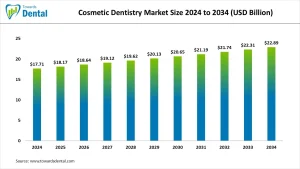

By Product Type
- Conventional Glass Ionomer
- Resin-Modified Glass Ionomer
- High-Strength Glass Ionomer
- Glass Ionomer Cements

Rohan Patil stands at the forefront of dental market research, leveraging over five years of specialized experience to navigate the intricate landscape of the global dental industry. As Principal Research Analyst at Towards Dental, he spearheads comprehensive research initiatives that encompass a broad spectrum of dental sectors, including orthodontics, periodontics, prosthodontics, and endodontics.
At Towards Dental, Rohan's expertise extends to analyzing emerging trends in dental technologies, regulatory frameworks, and market dynamics. He is instrumental in assessing the adoption of digital dentistry, advancements in dental materials, and the integration of artificial intelligence in diagnostic and treatment modalities.
Rohan's analytical acumen is complemented by his proficiency in translating complex data into actionable insights, enabling him to provide strategic recommendations that inform decision-making across the dental industry. His work not only supports dental professionals and organizations but also contributes to shaping the future trajectory of dental care globally. A trusted advisor and relentless innovator, Rohan continues to push the boundaries of traditional market research, merging scientific rigor with commercial insight to stay ahead in a fast-evolving dental landscape.
- Mobile Dental Unit Market Size to Attain USD 3.76 Billion by 2034 - January 6, 2026
- Dental Cone Beam CT Market Size to Attain USD 1,247.49 Million by 2034 - January 5, 2026
- Dental Resins Market Size to Lead USD 2.7 Billion by 2034 - January 2, 2026
Author
