
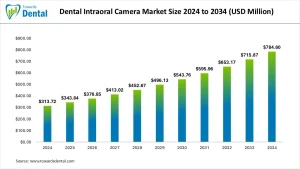
The global dental intraoral camera market reached USD 313.72 million in 2024 and is expected to climb to USD 784.6 million by 2034, expanding at a 9.60% CAGR, driven by rising digital dentistry adoption and demand for accurate chairside diagnostics.
What Key Drivers, Opportunities, and Challenges Are Shaping Growth in the Dental Intraoral Camera Market?
The dental intraoral camera market comprises handheld digital imaging equipment used to capture high-resolution images and videos of teeth, soft tissues, and intraoral anatomy. They enhance the detection of caries at its early stages, treatment planning, communication with patients at the chair, and management of digital records, all becoming part and parcel of the routine workflow in the dental field.
The market offers good opportunities, as dental practices are moving towards digital dentistry, preventive care, and open communication with patients. The downsides are that the cost of acquiring advanced imaging systems is high, maintenance is required, calibration is problematic, interoperability with older dental software is limited, and qualified operators are scarce in the developing world. Intraoral cameras are reusable, which requires sterilization and infection-control measures, which is a burden on high-volume practices.
How Do Regional Dynamics Influence the Global Adoption of Dental Intraoral Cameras?
North America leads in the prevalence of digital dentistry, the presence of imaging technology providers, and the performance of many restorative and periodontal procedures within private practice and specialized centers. The standards for digital imaging workflows are becoming more standardized across dental service organizations in the United States, so the use of intraoral cameras is an obligatory element of diagnosis.
There is also high penetration of modern dental technologies, centralized reimbursement schemes, and German, Italian, Swiss, and UK manufacturers of precision-imaging equipment. The Asia-Pacific region is expanding rapidly as multispecialty clinics scale, oral disease prevalence rises, and dental tourism accelerates in countries such as India, Thailand, South Korea, Japan, and China.
How will Digital Connections and AI Change the Intraoral Camera Landscape?
The dental intraoral camera market is transforming due to technological advances such as AI-based imaging, cloud-based solutions, and ergonomic sensor designs. Contemporary tools feature built-in autofocus, 4K-level video display, desktop lighting balance, and anti-fog lenses to deliver sharp images even in tricky areas of the mouth. AI image sensitivity is increasingly being applied to automatically recognize early caries, surface cracks, calculus, plaque deposits, and gingival inflammation, assisting clinicians in increasing diagnostic accuracy and minimizing missed conditions.
The use of cameras connected to electronic health records and digital treatment planning software facilitates the transfer of information, monitoring of patients in the chair, and remote consultation, thereby enhancing the use of tele-dentistry.
Dental Intraoral Camera Market Statical Scope

By Type
- Wired
- Wireless

Rohan Patil stands at the forefront of dental market research, leveraging over five years of specialized experience to navigate the intricate landscape of the global dental industry. As Principal Research Analyst at Towards Dental, he spearheads comprehensive research initiatives that encompass a broad spectrum of dental sectors, including orthodontics, periodontics, prosthodontics, and endodontics.
At Towards Dental, Rohan's expertise extends to analyzing emerging trends in dental technologies, regulatory frameworks, and market dynamics. He is instrumental in assessing the adoption of digital dentistry, advancements in dental materials, and the integration of artificial intelligence in diagnostic and treatment modalities.
Rohan's analytical acumen is complemented by his proficiency in translating complex data into actionable insights, enabling him to provide strategic recommendations that inform decision-making across the dental industry. His work not only supports dental professionals and organizations but also contributes to shaping the future trajectory of dental care globally. A trusted advisor and relentless innovator, Rohan continues to push the boundaries of traditional market research, merging scientific rigor with commercial insight to stay ahead in a fast-evolving dental landscape.
- Mobile Dental Unit Market Size to Attain USD 3.76 Billion by 2034 - January 6, 2026
- Dental Cone Beam CT Market Size to Attain USD 1,247.49 Million by 2034 - January 5, 2026
- Dental Resins Market Size to Lead USD 2.7 Billion by 2034 - January 2, 2026
Author
