
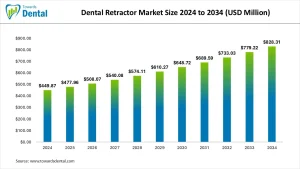
The dental retractor market was valued at USD 449.87 million in 2024 and is expected to reach USD 828.31 million by 2034 at a CAGR of 6.3%, driven by rising dental procedures and growing demand for advanced intraoral instruments.
What Makes Dental Retractors Essential for Modern Clinical and Minimally Invasive Procedures?
The dental retractor market comprises specialized instruments used to retract soft tissues, lips, cheeks, and gingiva out of the operating area, allowing clinicians to carry out restorative, periodontal, orthodontic, and surgical procedures with greater precision. This equipment facilitates better visibility, steady access, and the manipulation of the equipment under control during even the most complex procedures and is therefore irreplaceable in the modern clinical facility.
The market potential is growing, driven by the increasing use of minimally invasive procedures in dental clinics, the popularity of aesthetic dentistry, and the need for better tissue management in interdisciplinary surgical practices. Titanium, reinforced polymers, and medical-grade stainless steel, which are materials of high grade, increase the cost of procurement, especially in resource-constrained environments, and reusable systems bring about sterilization overheads and compliance demands regarding correct procedures of reprocessing.
How Are Regional Capabilities and Clinical Advancements Shaping the Global Dental Retractor Market?
North America is a powerful region, with a strong system of dental professionals, extensive procedures in restorative and surgical dentistry, and the widespread use of ergonomically designed surgical retractors. The emphasis on dental offices and hospital-based surgical centers on precision tools to aid in the preparation of implants, periodontal flap surgery, and trauma management is increasing, enhancing the region’s leadership. Europe is a key center, as it has a longstanding history of engineering quality at the medical level in medical equipment and strong networks for distributing orthodontic, cosmetic, and oral surgical devices.
The Asia-Pacific region is the fastest-growing market, driven by the rising oral disease burden, the growing use of minimally invasive treatments, and the rapid expansion of multispecialty groups and dental hospitals. The high-technology retractors used in complex oral and cosmetic surgeries are in demand in medical dental tourism across a number of countries.
How Are Digital Technologies, Smart Tools, and Advanced Materials Transforming Retractor Design and Surgical Outcomes?
The dental retractor sphere has been greatly transformed by technological advancements, driven by the combination of digital dentistry, smart instruments, and improved materials to optimize surgical outcomes.
Engineering facilitates a high level of accuracy in modeling curvature, grip patterns, and pressure distribution using CAD, and hence retractors are designed to be ergonomically compatible with clinical mechanics and patient comfort. Periodontal, surgical, and implant retractors are increasingly being affected by AI-driven planning tools. The use of AI systems with imaging techniques like digital scanning and cone-beam 3D mapping helps clinicians understand how the soft tissues will behave, plan incisions effectively, and learn to locate likely obstruction areas that may require special retraction.
Dental Retractor Market Statical Scope

By Type
- Cheek Retractors
- Vestibular Retractors
- Implant Retractors
- Others

Rohan Patil stands at the forefront of dental market research, leveraging over five years of specialized experience to navigate the intricate landscape of the global dental industry. As Principal Research Analyst at Towards Dental, he spearheads comprehensive research initiatives that encompass a broad spectrum of dental sectors, including orthodontics, periodontics, prosthodontics, and endodontics.
At Towards Dental, Rohan's expertise extends to analyzing emerging trends in dental technologies, regulatory frameworks, and market dynamics. He is instrumental in assessing the adoption of digital dentistry, advancements in dental materials, and the integration of artificial intelligence in diagnostic and treatment modalities.
Rohan's analytical acumen is complemented by his proficiency in translating complex data into actionable insights, enabling him to provide strategic recommendations that inform decision-making across the dental industry. His work not only supports dental professionals and organizations but also contributes to shaping the future trajectory of dental care globally. A trusted advisor and relentless innovator, Rohan continues to push the boundaries of traditional market research, merging scientific rigor with commercial insight to stay ahead in a fast-evolving dental landscape.
- Mobile Dental Unit Market Size to Attain USD 3.76 Billion by 2034 - January 6, 2026
- Dental Cone Beam CT Market Size to Attain USD 1,247.49 Million by 2034 - January 5, 2026
- Dental Resins Market Size to Lead USD 2.7 Billion by 2034 - January 2, 2026
Author
