
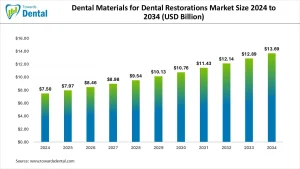
The dental materials for restorations market was valued at USD 7.5 billion in 2024 and is expected to reach nearly USD 13.69 billion by 2034, expanding at a 6.30% CAGR, driven by rising restorative procedures and advanced biomaterial adoption.
Why Is There High Demand in the Dental Materials for Dental Restorations Market?
Demand is increasing because restorative dentistry remains one of the most frequently performed dental services worldwide. The World Health Organization reported in 2022 that untreated dental caries affects approximately 2.5 billion people globally, making restorative interventions essential for maintaining oral function and aesthetics. As clinicians aim to preserve natural tooth structure, materials such as composite resins, glass ionomers, ceramics, bioactive materials and hybrid composites are being adopted at a faster pace. Patients also show a strong preference for natural-looking restorations, increasing the use of tooth-colored materials that offer both strength and aesthetic appeal.
The shift toward minimally invasive dentistry contributes significantly to the market’s expansion. Modern restorations rely on adhesive materials that support conservative cavity preparation and long-term bonding. High-strength ceramics and lithium disilicate materials remain preferred for crowns and onlays. At the same time, composite resins dominate direct restorations due to improvements in wear resistance, handling properties and shade-matching capabilities. Growth of dental insurance, expansion of private dental clinics and rising awareness of preventive and cosmetic dentistry further support global demand.
What Are the Obstacles Holding Back Growth in the Dental Materials for Dental Restorations Market?
Despite strong adoption, several challenges restrict broader market growth. High costs associated with premium ceramic blocks, zirconia, and advanced bonding systems limit access in low- and middle-income regions. Many developing countries still rely heavily on amalgam due to affordability, despite global efforts to phase down mercury-containing materials under the Minamata Convention. Limited clinician training in advanced composite layering techniques, ceramic handling and digital workflows can also reduce treatment quality and slow adoption of newer materials.
Inconsistencies in regulatory frameworks add further obstacles. Restorative materials must comply with strict biocompatibility and safety standards, which lengthen development cycles for manufacturers. Longevity concerns also influence patients’ decisions, as direct composite restorations may require more frequent maintenance than ceramic alternatives. Supply chain limitations in certain regions affect access to high-quality bonding agents, impression materials, and CAD/CAM-compatible blocks, slowing market penetration.
What Does the Regional Landscape of the Dental Materials for Dental Restorations Market Look Like?
North America leads the global market due to its high volume of restorative procedures, strong dental insurance coverage and widespread use of advanced ceramic and composite systems. Dental clinics and laboratories in the United States and Canada frequently adopt cutting-edge materials that support digital workflows, including high-translucency zirconia, resin-based nano-hybrids and bioactive composites.
Europe follows closely, supported by strong adherence to preventive dentistry, high training standards among clinicians and well-regulated dental-material markets. Countries such as
Germany, France, the United Kingdom and the Nordic region prioritise durable, aesthetic restorations and advanced bonding techniques, promoting steady demand for premium materials.
Asia Pacific is the fastest-growing region, driven by rising dental tourism, expanding private dental hospitals and increasing awareness of cosmetic dentistry. China, India, Japan and South Korea are experiencing rapid growth in restorative treatments as middle-class populations expand and digital CAD/CAM systems become more widely accessible. Latin America shows consistent progress, particularly in Brazil and Mexico, where private dental networks are modernising. The Middle East and Africa are growing gradually as private clinics invest in modern dental materials, though affordability and access remain limiting factors.
How Is Technology Changing the Dental Materials for Dental Restorations Market?
Technology is transforming material performance, design precision and clinical workflows. CAD/CAM systems enable accurate milling of zirconia, lithium disilicate, and hybrid ceramic blocks, improving restoration fit, aesthetics, and longevity. Digital impressions reduce distortions associated with traditional molds, enhancing the performance of restorative materials.
Bioactive materials are also gaining popularity. These materials release fluoride, calcium and phosphate ions to promote remineralisation and improve tooth health. Nano-hybrid and nano-ceramic composites offer superior polishability, wear resistance and color stability, supporting better clinical outcomes. AI-driven diagnostic tools assist in cavity detection, material selection and treatment planning, allowing clinicians to match restorative materials to patient-specific risk profiles. As digital workflows expand, material science innovations continue to elevate the quality, durability and aesthetics of modern dental restorations.
Dental Materials for Dental Restorations Market Statical Scope

By Material Type
- Composite Resins
- Ceramics
- Amalgam
- Glass Ionomer Cement
- Gold and Other Metals

Rohan Patil stands at the forefront of dental market research, leveraging over five years of specialized experience to navigate the intricate landscape of the global dental industry. As Principal Research Analyst at Towards Dental, he spearheads comprehensive research initiatives that encompass a broad spectrum of dental sectors, including orthodontics, periodontics, prosthodontics, and endodontics.
At Towards Dental, Rohan's expertise extends to analyzing emerging trends in dental technologies, regulatory frameworks, and market dynamics. He is instrumental in assessing the adoption of digital dentistry, advancements in dental materials, and the integration of artificial intelligence in diagnostic and treatment modalities.
Rohan's analytical acumen is complemented by his proficiency in translating complex data into actionable insights, enabling him to provide strategic recommendations that inform decision-making across the dental industry. His work not only supports dental professionals and organizations but also contributes to shaping the future trajectory of dental care globally. A trusted advisor and relentless innovator, Rohan continues to push the boundaries of traditional market research, merging scientific rigor with commercial insight to stay ahead in a fast-evolving dental landscape.
- Mobile Dental Unit Market Size to Attain USD 3.76 Billion by 2034 - January 6, 2026
- Dental Cone Beam CT Market Size to Attain USD 1,247.49 Million by 2034 - January 5, 2026
- Dental Resins Market Size to Lead USD 2.7 Billion by 2034 - January 2, 2026
Author
