
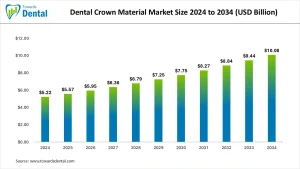
The dental crown material market was valued at USD 5.22 billion in 2024 and is expected to reach nearly USD 10.08 billion by 2034, expanding at a 6.8% CAGR, driven by rising restorative procedures and demand for durable, aesthetic materials.
What Factors Are Accelerating the Expansion of the Dental Crown Materials Market?
The dental crown materials market includes restorative materials used to create artificial crowns worn to rebuild tooth structure, provide restoration, and improve aesthetics when tooth decay, fracture, attrition, or post-endodontic weakening has occurred. The market presents opportunities driven by increasing demand for cosmetic dentistry, the growing adoption of chairside CAD/CAM milling, the expansion of zirconia-based restorations, and the rising use of biocompatible, long-lasting tooth-colored materials. However, limitations include high prices for high-quality ceramics and multilayered zirconia blocks, technical accuracy in digital milling, material variability in low-income areas, and the transition of clinicians to new high-technology fully ceramic systems.
How Do Regional Trends Shape the Demand for Dental Crown Materials?
North America is the leading region owing to strong support for dental insurance, high levels of cosmetic restoration procedures, and the use of both CAD/CAM systems in laboratories and in chairside practice. The United States is given the position of having its own developed network of dental service institutions, specialized restorative clinics, and manufacturers of zirconia, hybrid materials, and high-strength aesthetic ceramics.
Another key area with extensive engineering knowledge in ceramic science, adherence to high manufacturing standards, and a long history of metal-ceramic and all-ceramic research that underpins uniform clinical adoption is in Europe. France, Germany, and Italy are playing their roles in specialised labs and strong distribution networks. The Asia-Pacific region is the most rapidly growing landscape, with an increasing number of middle classes demanding cosmetic interventions, rapid urbanization of dental practices, and greater access to restorative procedures in India, China, Japan, Thailand, as well as in South Korea.
How Is Technology Redefining the Future of Dental Crown Materials?
The influence that technological development produces on the market of dental crown materials is rather substantial because AI, digital solutions, and advanced engineering are capable of affecting the process of designing, creating, and optimizing restorations. AI-powered diagnostic tools can help clinicians make the most significant decision regarding the choice of crown material, based on occlusal load, tooth placement, esthetic considerations, and long-term prognosis. The software used in intelligent design allows detection of margins, anatomical contouring, and occlusion mapping to be fully automated with the help of digital scanners, making it unnecessary to adjust the chairside and thereby improving accuracy.
AI shade-matching solutions allow for more accurate aesthetics and reduce the number of remakes, in contrast to cloud-based solutions that help with communication between labs and clinics and enable the design consultation process to be conducted remotely.
Dental Crown Material Market Statical Scope

By Material
- Ceramic
- Metal
- Composite Resin
- Zirconia
- Porcelain-Fused-to-Metal

Rohan Patil stands at the forefront of dental market research, leveraging over five years of specialized experience to navigate the intricate landscape of the global dental industry. As Principal Research Analyst at Towards Dental, he spearheads comprehensive research initiatives that encompass a broad spectrum of dental sectors, including orthodontics, periodontics, prosthodontics, and endodontics.
At Towards Dental, Rohan's expertise extends to analyzing emerging trends in dental technologies, regulatory frameworks, and market dynamics. He is instrumental in assessing the adoption of digital dentistry, advancements in dental materials, and the integration of artificial intelligence in diagnostic and treatment modalities.
Rohan's analytical acumen is complemented by his proficiency in translating complex data into actionable insights, enabling him to provide strategic recommendations that inform decision-making across the dental industry. His work not only supports dental professionals and organizations but also contributes to shaping the future trajectory of dental care globally. A trusted advisor and relentless innovator, Rohan continues to push the boundaries of traditional market research, merging scientific rigor with commercial insight to stay ahead in a fast-evolving dental landscape.
- Mobile Dental Unit Market Size to Attain USD 3.76 Billion by 2034 - January 6, 2026
- Dental Cone Beam CT Market Size to Attain USD 1,247.49 Million by 2034 - January 5, 2026
- Dental Resins Market Size to Lead USD 2.7 Billion by 2034 - January 2, 2026
Author
