
The dental training simulators market was valued at USD 370 million in 2024 and is expected to reach nearly USD 1,120 million by 2034, expanding at an 11.7% CAGR, driven by rising adoption of digital simulation and enhanced clinical training needs.
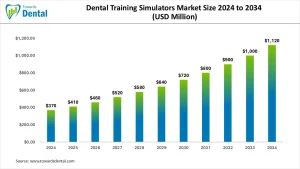
What Key Factors Are Powering the Expansion of the Dental Training Simulators Market?
The dental training simulators market comprises digital and physical simulation platforms used to teach preclinical and clinical skills to dental students, dental residents, and clinicians. These systems include the phantom heads, virtual reality simulators, haptic-enabled training units, digitally guided operative modules, and integrated evaluation software. The market opportunity is growing as dental institutions adopt simulation-based training to ensure competency, mitigate patient-related risks, and standardize skill measurement.
Rising demand for structured clinical training, the international shortage of skilled faculty, and the need for further reinforcement of advanced training platforms underscore the need for advanced training platforms. However, the market is also limited by the high cost of advanced VR and haptic systems, the necessity of regular software updates, the complexity of maintenance, and limited access in low-resource areas.
How Are Global Regions Shaping the Adoption of Dental Training Simulation Technologies?
North America dominates the market, as its attention is a key factor in high-quality dental education, the broad use of simulation training, and the development of VR and haptic technologies. The modernization of curricula in dental schools in the United States and Canada has included interactive training systems, online grading systems, and patient-scenario simulators, which increase confidence in clinical care before direct patient care.
Europe is also in a strong position with well-developed academic institutions, preclinical laboratories, and well-developed technological expertise in medical simulation. Germany, France, the UK, Switzerland, and the Nordic region are among the countries where there has been a steady introduction of simulation-based teaching, in tandem with high levels of regulatory and educational standards. The Asia-Pacific market is becoming the most dynamic due to rising investments in dental colleges, an increasing number of privately owned dental universities, and growing numbers of students in India, China, Japan, South Korea, and Australia.
How Are AI and Advanced Technologies Revolutionizing Dental Training Simulators?
The dental simulators training market is being reshaped by the evolution of AI and high-tech solutions to achieve a higher degree of realism and assessment accuracy, as well as to personalize the learning process. AI-based analytics measure students’ performance by
evaluating parameters such as hand stability, instrument angulation, pressure application, margin accuracy, and procedure time, resulting in objective competency scores.
Virtual reality systems provide an operating room experience that creates anxiety, movement, changes in lighting, and clinical complexity, and aid learners in acquiring clinical judgement and situational awareness. CBCT data integration, digital impression, and AI-informed procedural planning contribute to the even greater depth of training.
Dental Training Simulators Market Statical Scope
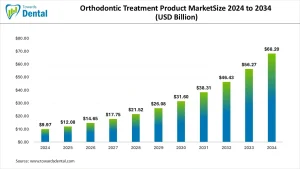
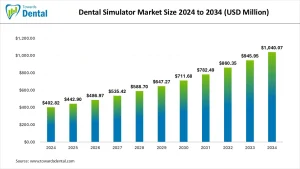

Rohan Patil stands at the forefront of dental market research, leveraging over five years of specialized experience to navigate the intricate landscape of the global dental industry. As Principal Research Analyst at Towards Dental, he spearheads comprehensive research initiatives that encompass a broad spectrum of dental sectors, including orthodontics, periodontics, prosthodontics, and endodontics.
At Towards Dental, Rohan's expertise extends to analyzing emerging trends in dental technologies, regulatory frameworks, and market dynamics. He is instrumental in assessing the adoption of digital dentistry, advancements in dental materials, and the integration of artificial intelligence in diagnostic and treatment modalities.
Rohan's analytical acumen is complemented by his proficiency in translating complex data into actionable insights, enabling him to provide strategic recommendations that inform decision-making across the dental industry. His work not only supports dental professionals and organizations but also contributes to shaping the future trajectory of dental care globally. A trusted advisor and relentless innovator, Rohan continues to push the boundaries of traditional market research, merging scientific rigor with commercial insight to stay ahead in a fast-evolving dental landscape.
- Mobile Dental Unit Market Size to Attain USD 3.76 Billion by 2034 - January 6, 2026
- Dental Cone Beam CT Market Size to Attain USD 1,247.49 Million by 2034 - January 5, 2026
- Dental Resins Market Size to Lead USD 2.7 Billion by 2034 - January 2, 2026
Author
